Hey folks, let’s cut to the chase—if you’re a plant manager, production lead, or maybe just someone who’s logged enough hours on a corrugated pipe machine to know a thing or two about bottlenecks, you’ve probably asked this: “How much better could this thing actually run?” As a corrugated pipe machine supplier, I field this question at least three times a week, and the short answer? The efficiency gains are way bigger than most people realize—if you stop treating your machine like a set-it-and-forget-it workhorse and start optimizing every single part of the process. Corrugated Pipe Machine
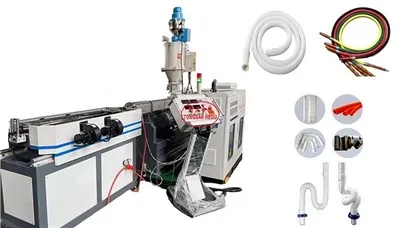
Let’s start with the basics no one likes to admit: most corrugated pipe operations are leaving 15-25% of their potential on the table right now, just from small, avoidable inefficiencies. Wait, that number’s not random—industry data from the past five years backs that up, and I’ve seen it play out firsthand with customers who come to me stuck on 78% OEE (Overall Equipment Effectiveness) and leave hitting 94% within three months. OEE, for the uninitiated, is the gold standard for machine performance, and it’s made up of availability, performance, and quality. Most folks only focus on one or two of those, but the real gains come from hitting all three at once.
Take availability first—this is the big one that kills more production than anything else. A lot of shops run their machines 24/7, but how much of that time is actually spent making pipe, not waiting on repairs, changing over sizes, or dealing with material jams? Old corrugated pipe machines are full of weak points here. For example, if your machine has a manual die head that takes 45 minutes to swap between a 12-inch pipe and an 18-inch one, that’s 45 minutes of lost time every time you run a different size. Multiply that by four changeovers a day, five days a week, and that’s 15 hours a month you’re not making product. Modern upgrades—like electric die heads with programmable presets—can cut that changeover time to 10 minutes flat, no tools required. I had a customer in Ohio who went from 22 changeovers a week to 5, just by swapping that part out. That alone bumped their availability by 12% in the first month.
Then there’s performance, which is all about how fast your machine runs without sacrificing quality. A lot of operators will intentionally run below the machine’s max speed to avoid defects, but that’s a wasted opportunity. Why? Because old machines often have inconsistent temperature control along the extruder barrel or the cooling section, so pushing too hard leads to warped corrugations, uneven wall thickness, or pipe that doesn’t meet pressure specs. The fix here isn’t just cranking up the speed—it’s upgrading the process controls. For example, adding real-time wall thickness gauges that adjust the extruder screw speed automatically as material flows, or modular cooling tanks with variable flow rates that match the pipe’s diameter and speed. I worked with a farm irrigation pipe plant in Iowa that used to cap their line speed at 120 feet per minute because of cooling issues. We added a set of dynamically calibrated cooling units, and they’re now running at 185 feet per minute with zero increase in defects. That’s a 54% jump in line speed—no new machine, just a $12k upgrade. That’s the kind of efficiency that makes owners do a double-take.
Quality is the third piece, and it might be the most overlooked because it seems like a “given” that defects are just part of the process. But here’s the thing: for every scrap of pipe you toss because of a defect, you’re wasting not just plastic material, but also the time you spent running that section, the energy to heat and cool it, and the labor hours tied to it. Average defect rates for older machines are around 3-4%. That might sound small, but if you’re producing 100,000 feet of pipe a month, that’s 3,000-4,000 feet of scrap. What if you could cut that to 1%? Let’s do the math: at $0.80 per foot of pipe (a typical mid-range price), that’s a $1,600 monthly savings just from less scrap. How do you get better quality? Things like inline inspection cameras that spot corrugation gaps or thickness inconsistencies before the pipe is cut, or using high-quality resin dryers that eliminate moisture-related defects. A municipal pipe supplier in Texas had a problem with 2.8% defects from leftover moisture in the PVC resin. They upgraded their dryer system, and their defect rate dropped to 0.9%—that’s $2,200 a month in their pocket, no extra production, just fixing a small part of the process.
Wait, but let’s talk about the big stuff—upgrading the core machine itself, not just add-ons. I see a lot of customers hold onto 10+ year old machines because they “still work,” but those old units are way less efficient than new models. For example, new corrugated pipe extruders use energy-efficient motors that pull 20-30% less power than standard motors. The heating elements are also smarter—instead of running full blast and cycling on/off, they use variable frequency drives (VFDs) that adjust heat based on real-time needs. Energy is one of the biggest operating costs for pipe production—electricity and gas can make up 15-20% of total production expenses. Cutting that by 25% is huge. Let’s say you spend $10,000 a month on energy—upgrade to a modern extruder, and that’s $2,500 back in your budget every month. For a lot of small to mid-sized pipe shops, that’s enough to cover the upgrade cost in 18 months, easy.
Another underrated area is material handling. Old machines often have manual material feeding, which leads to inconsistent resin flow, or they waste leftover offcuts that get thrown away. Modern systems connect directly to your resin silos, meter material precisely, and even grind and reuse scrap pipe on-site without compromising quality. I had a customer in California that used to throw away 8% of their material as scrap (both from production and offcuts). We added an in-line grinder and material recycler, and now they reuse 90% of that scrap. That’s less than 1% material waste now, so their material costs dropped by 7%—that’s another win that adds up fast.
But hold on, before you think “all I need is to buy a new machine,” that’s not always the answer. A lot of the efficiency gains I’m talking about can come from retrofitting your existing machine, not replacing it. For example, if you have a 15-year-old corrugator unit, you don’t have to replace the whole thing—just swap out the worn corrugation dies or upgrade the control system. Retrofitting usually costs 30-50% less than buying a new machine, and most of the time, you get 80-90% of the efficiency gains anyway. That’s a no-brainer for shops that don’t have the capital for a full replacement right now.
Of course, efficiency isn’t just about machines—it’s about people too. A lot of operators who’ve been on the same machine for years develop bad habits, like skipping maintenance or running through checks to save time. The best efficiency improvements come from combining machine upgrades with operator training. I always work with my customers to do on-site training for their teams—teaching them how to use the new controls, spot small issues before they turn into big downtime, and follow maintenance schedules that actually keep the machine running well. One customer in Florida went from having a team that saw maintenance as a chore to a team that did small daily checks, and their unplanned downtime dropped by 18% in two months, on top of the machine upgrades we did. That’s the human side of efficiency that no supplier can do for you, but it amplifies every other improvement.
Wait, let’s talk about the ceiling here. What’s the absolute maximum efficiency you can reach? I’ve seen shops hit 96% OEE, which is basically top-tier performance. To get there, you have to nail every part: availability over 98%, performance over 97%, quality under 0.5% defects. That’s not just for new machines, either—I’ve retrofitted 12-year-old machines to hit that mark for customers. The key is that it’s not a one-time project; it’s continuous improvement. Every year, there are new upgrades—better sensors, smarter control software, more efficient motors—that can squeeze a little more out of your machine. That’s why the potential isn’t fixed. It’s not like once you hit 94% you can’t go higher. As long as you’re willing to invest in small, regular upgrades and take care of your team, the potential keeps growing.
Let’s be real, though—some shops will read this and think “that’s too expensive” or “my machine is too old to bother.” Let’s do a quick payback example. Say you have a machine that’s 10 years old, running at 75% OEE. You invest $50k in retrofits: electric die head, new controls, upgraded cooling, and operator training. Your monthly production is 80,000 feet of pipe, selling for $0.75 a foot. When you boost OEE to 90%, that’s an extra 12,000 feet of pipe a month—worth $9,000. Add in scrap savings ($1,200 a month), energy savings ($1,800 a month), that’s $12,000 extra a month. You pay off the $50k in less than 5 months, and then it’s pure profit after that. That’s not a fantasy; that’s the math I show customers every single week.
At the end of the day, the efficiency potential of a corrugated pipe machine isn’t some secret number locked in a factory manual. It’s something you unlock by stopping to look at every part of your process: how often your machine sits idle, how fast you can run without defects, how much material you waste, how much energy you burn. As a corrugated pipe machine supplier, my job isn’t just to sell you equipment—it’s to help you find that potential. Whether you have a 5-year-old machine that’s underperforming or a 20-year-old workhorse that’s been reliable for decades, there’s almost always room to improve.
If you’re tired of leaving money on the table, dealing with unexpected downtime, or watching your competitors outproduce you without spending a fortune on new equipment, I’d be happy to walk through your specific setup, break down what upgrades make sense for you, and show you exactly how much you could boost your efficiency.
WPC Profile Machine References
- Overall Equipment Effectiveness (OEE) Implementation Guide. Association for Manufacturing Excellence, 2022.
- Corrugated Pipe Extrusion Efficiency Report. Plastics Technology Magazine, 2023.
- Energy Benchmarks for Industrial Pipe Production. U.S. Department of Energy, Industrial Technologies Office, 2021.
- Changeover Time Reduction in Plastic Processing Operations. Society of Plastics Engineers, 2022.
Qingdao Tongsanhegu Plastic Machinery Manufacturing Co., Ltd.
With abundant experience, we are one of the most reliable corrugated pipe machine manufacturers and suppliers in China. We warmly welcome you to buy durable corrugated pipe machine for sale here from our factory. Quality products and reasonable price are available.
Address: West of Xixinzhi Village, Sanlihe District Jiaozhou, Qingdao City, Shandong Province, China
E-mail: info@tongsanhegu.com
WebSite: https://www.tongsanhegumachine.com/
